


///FoWaBa-Bio
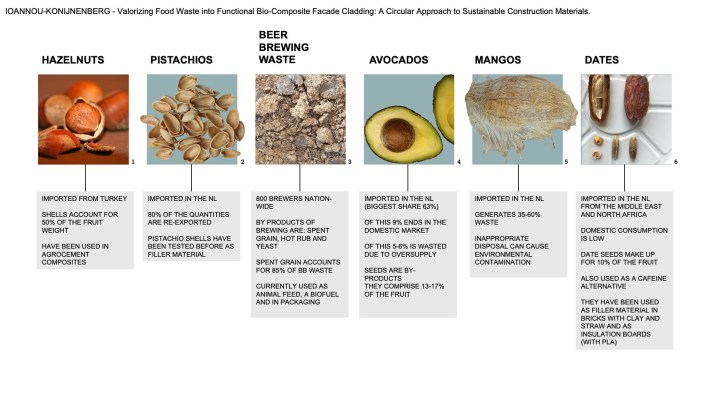
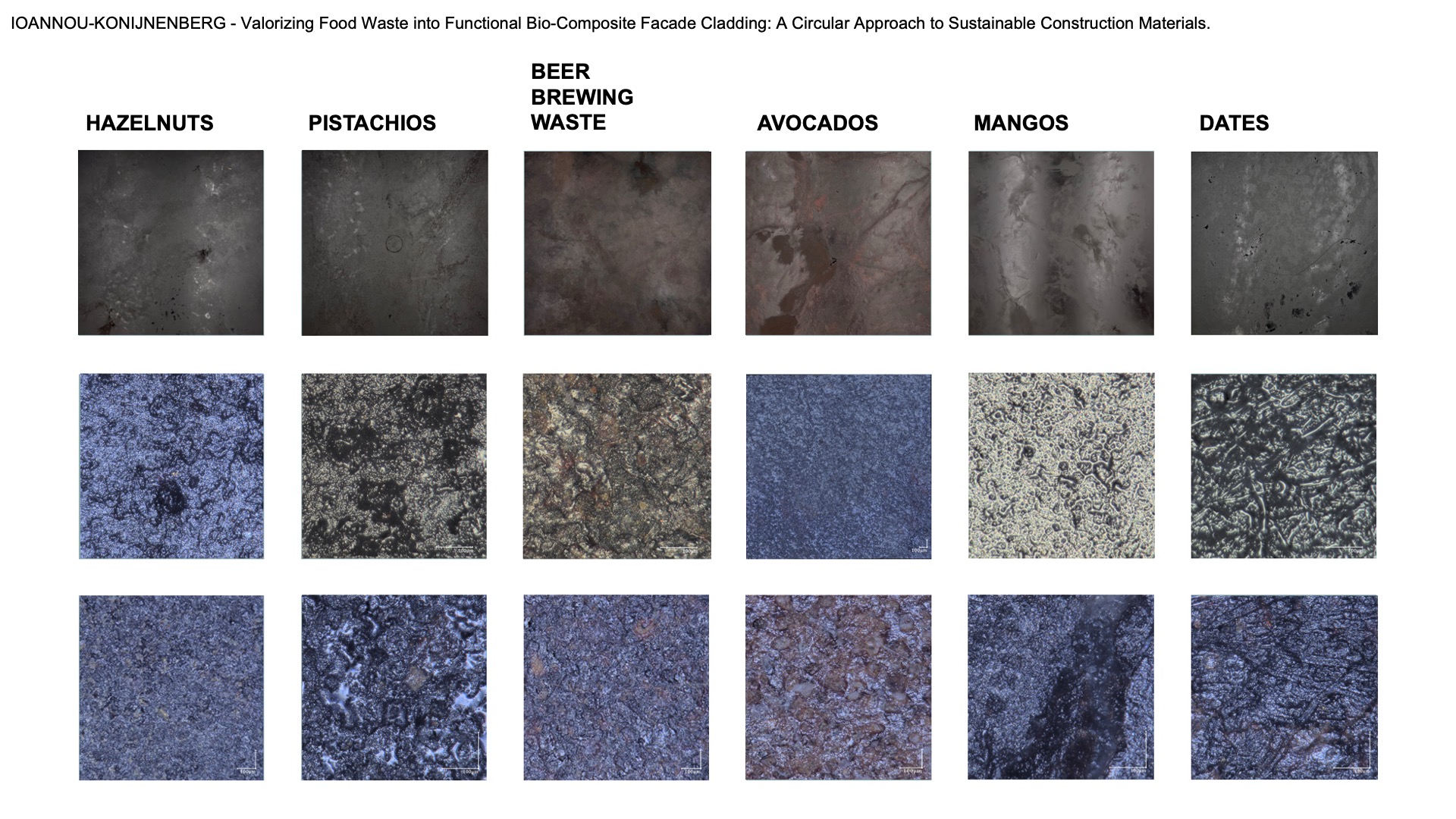
The FoWaBa-Bio project (Food-Waste Based Bio composites) investigated whether food-waste streams available in the Netherlands can be valorized into high-performance bio-composite façade cladding materials and developed into an integrated, demountable façade tile system. The project combined material science research with architectural design and prototyping to bridge the gap between laboratory feasibility and building-scale application. On the material level, seven food-waste streams were investigated: hazelnut shells, pistachio shells, beer brewing waste, mango kernels, avocado pits, spent tea leaves, and date seeds. These were processed into fine granular fillers and combined with a bio-based furan resin. Flat composite sheets were produced and systematically tested for flexural strength, stiffness, impact resistance, water absorption, and freeze–thaw durability. Optical microscopy was used to assess microstructural homogeneity and damage mechanisms. The results demonstrated that food-waste fillers are not interchangeable: hazelnut and pistachio shells significantly outperformed the other streams, achieving flexural strengths up to 62.6 MPa and showing low water uptake, high durability, and stable processing behavior. These two fillers were identified as technically suitable for façade cladding applications.
Lead Research at TU Delft: Olga Ioannou
Project partners: TU Delft, NPSP, TGV
All results of the first stage of research (material composition) have been published here.
 facadeworld