


During her PhD at Cambridge, our colleague Alessandra Luna Navarro, in collaboration with the Permasteelisa Group, developed the innovative MATE Lab—the Mobile Adaptive Technology Experimental Lab—a bespoke façade test chamber designed to study occupant–façade interaction in realistic office settings.
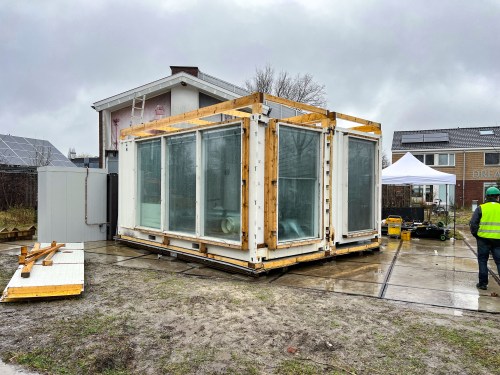
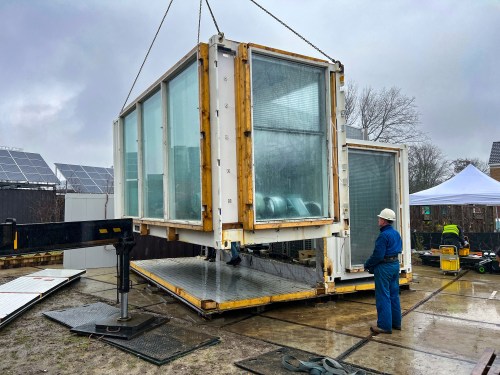
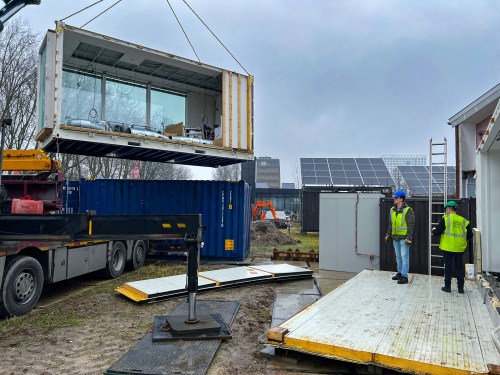
Years have passed since Alessandra’s departure from Cambridge, but the two container modules that comprise the lab—designed to simulate real-world office conditions and human behavior—were preserved and have now made the journey to Delft and placed at the Green Village. Despite weather challenges and rigorous logistics, both modules were safely placed, sealed, and primed for reassembly.
Stay tuned—more updates on the MATE Lab and its future experiments will follow. In the meantime, we couldn’t resist sharing these first snapshots!
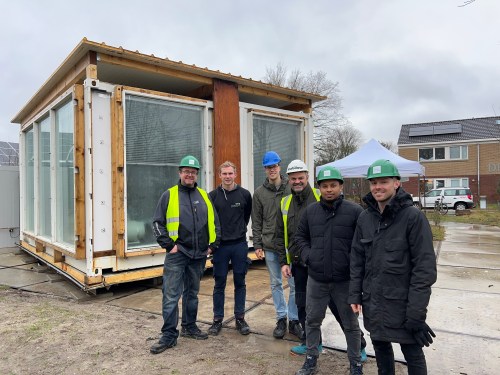
Thanks to the team including Dieter Callewaeart from Permasteelisa group, Pablo Martinez Alcaraz and Pedro are la Barra Luegmayer , Nando Versteeg from the Green Village, Mohammed Ibrahim and Marcel Bilow.
additional :
- Research Focus & Impact
At TU Delft, Alessandra now serves as an Assistant Professor in the Architectural Façades and Products Research Group. Her work centers on human–building interaction, enhancing climate resilience, resource efficiency, occupant well-being, and health. She leads both the MATE Lab and SMART Lab, supervising PhD students conducting cutting-edge façade experiments and controls TU Delft Research Portal. - MATE Lab’s Technical Contributions
The MATE Lab enabled novel multi-domain investigations into occupant comfort—covering visual, thermal, acoustic, and air-quality dimensions—using both subjective surveys and objective environmental monitoring. The insights gained shed new light on how façade technologies and dynamic control strategies influence occupant satisfaction and energy performance Cambridge RepositoryResearchGate.
 facadeworld